
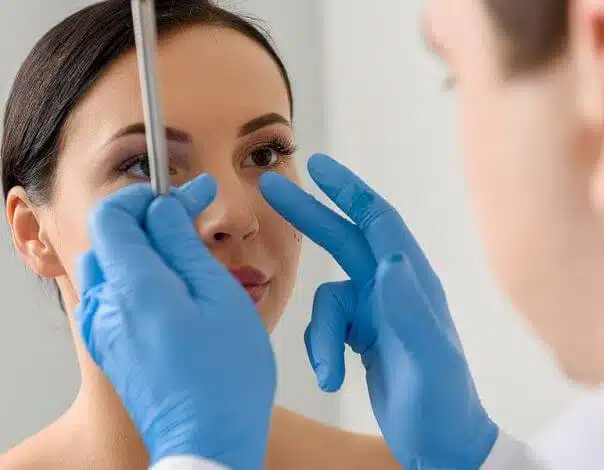
Wait four weeks before blowing your nose after rhinoplasty. It’s tempting when you feel stuffy, but blowing your nose too soon can disrupt healing and cause a nosebleed.
The cold-like stuffiness usually lasts about three to five days, and most people are back at work in about a week or so.
Wait Four Weeks Before Blowing Your Nose After Rhinoplasty
Dr. Siegel gives his patients a four-week timeline. It starts the day of your surgery and applies even to gentle blowing; after that, start gently. Timelines vary from surgeon to surgeon, so if you had surgery elsewhere, follow your surgeon’s timeline.
Feeling stuffy in the first few days after rhinoplasty is normal, and it usually feels more like a cold than real pain. Dr. Siegel uses thin splints inside your nose rather than packing it with gauze. Swelling causes most of the stuffiness, and the splints can make your nose produce extra mucus until they come out with your external splint, usually seven to ten days after surgery. Dr. Siegel also sees you the day after surgery to clean your nose.
What to Do Instead of Blowing Your Nose
- If you need to sneeze, sneeze with your mouth wide open, so less pressure goes through your nose
- Sleep with your head elevated for the first week
- Apply a small dab of Vaseline or Aquaphor inside your nose three to four times a day, and we’ll show you how the day after surgery
- Flying in the first week? Spray a decongestant such as Afrin 20 to 60 minutes before departure, and don’t use it more than twice
What Happens If You Blow Your Nose Too Soon After Rhinoplasty?
Blowing too soon presses on tissue that’s still healing and can start a nosebleed. If you notice heavy bleeding, call our office right away.
Blowing Your Nose After Septoplasty or Septorhinoplasty
When Dr. Siegel straightens your septum during the same operation, it typically doesn’t extend your recovery time, and the four-week wait remains the same.
Learn more about septoplasty, or about having rhinoplasty and septoplasty together.


Keep Pressure Off Your Nose While It Heals After Rhinoplasty
The reason you wait to blow your nose applies to anything else that pushes on it during the first several weeks.
When Can I Exercise After Rhinoplasty?
Give yourself at least three weeks before vigorous exercise, heavy lifting, or anything that makes you strain, because straining can bring on a nosebleed. Your nose won’t feel painful by then, but it can still be injured, so be careful not to bump or squeeze it. Children and pets are the most common cause of accidental bumps.
Learn more about how soon you can exercise after a nose job.
When Can I Go Back to Work After Rhinoplasty?
Most patients go back to work about a week after surgery, when the external splint comes off. Bruising is typically minimal with ultrasonic rhinoplasty, so many feel comfortable being seen by then.
If your job involves lifting, bending, or physical effort, plan on more time, since heavy lifting and straining are off-limits for at least three weeks.
Can I Wear Glasses After Rhinoplasty?
You may be able to wear glasses again once the external splint comes off, about a week after rhinoplasty, depending on the type and weight of your frames. Check with Dr. Siegel first, since the right timing depends on your surgery.
You may see four to six weeks recommended elsewhere, including in Mayo Clinic’s rhinoplasty guide and the University of Mississippi Medical Center’s rhinoplasty instructions. Those are general rules for every patient. What matters more is your own surgery, how your nasal bones were treated, and how much pressure your glasses put on the bridge.
How Your Nose Looks and Feels as It Heals After Rhinoplasty
How Swollen Will My Nose Be After Rhinoplasty?
Some swelling is normal after any rhinoplasty, but with ultrasonic rhinoplasty it’s typically milder. Dr. Siegel uses this more precise technique to cause less trauma to the surrounding tissue, so there’s usually less swelling and bruising than with traditional rhinoplasty, and you can see the shape of your new nose sooner.
Most swelling improves over the first few weeks, and your nose looks more defined as it goes down. The bridge settles first, and the tip takes longer, since a little swelling there can last several months as your nose continues to refine.
Learn more about how to reduce swelling after rhinoplasty.


Should I Use Cold Compresses After Rhinoplasty?
Cold compresses help keep swelling down during the first 24 hours after surgery:
- Use cool, clean compresses, or a bag of frozen corn wrapped in a dry cloth
- Rest them gently on your closed eyes four to six times during that first day
- Keep them off your nose itself
Will I Have a Scar After Rhinoplasty?
Most patients won’t have a visible scar after rhinoplasty, because most rhinoplasties Dr. Siegel performs are closed, with every incision inside your nose. Structural and revision cases may need an open approach, which adds a small incision across the columella, the strip of skin between your nostrils. Once it heals, that scar is typically undetectable. If you’re not sure which approach suits your nose, Dr. Siegel will go over it with you.
To help external stitches heal faster, keep them moist for the first week by applying Aquaphor two to three times a day. Any stitches that don’t dissolve come out at the same time as your external splint.
When Should I Call Your Office After Rhinoplasty?
Call us at 832-358-3223 if you notice any of these:
- A temperature above 101°F
- A large amount of bleeding from your nose
- A significant bump or injury to your nose
- Pain that keeps getting worse and isn’t eased by your prescribed medication
After hours, you can reach Dr. Siegel directly. His cell number is in your post-op instructions. If you can’t reach us or Dr. Siegel, go to the emergency room.
Planning Your Rhinoplasty? Meet Dr. Siegel in Houston
Ultrasonic rhinoplasty reshapes the nasal bones without traditional bone breaking, and its vibrations leave nearby tissue and blood vessels largely untouched. Dr. Siegel often pairs it with preservation rhinoplasty, which keeps your nose’s natural ligaments and support intact to help it stay strong and stable over the long term.
If you’re still deciding whether surgery is right for you, find out what makes a good candidate for rhinoplasty. Scheduled or already recovering? Read through our rhinoplasty post-op instructions.
“The day I got my splint off earlier this week you would not have been able to tell I had had surgery! The recovery process was a breeze . . . . I had minimal swelling following the surgery and no bruising.”
—Lydia Z.
You don’t need every answer before your consultation. Bring your questions, and we’ll go through them with you.
Dr. Michel Siegel is board-certified in both ENT and facial plastic surgery, with rhinoplasty at the center of his practice. He’ll listen to your goals, examine your nose, and use computer imaging to talk through refinements that keep you unmistakably you, along with what your recovery would look like. He does your consultation, surgery, and follow-ups himself.
We see patients from across Houston and Texas, at our West Houston office or by video. If you’re traveling in, we can also help you plan your stay, and financing through Cherry or CareCredit is available.